

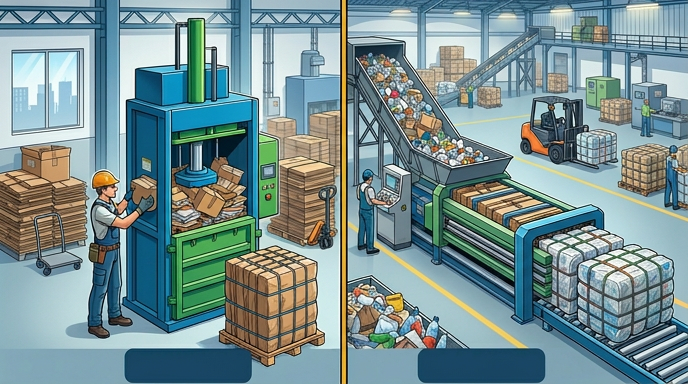
In today's environmentally conscious world, effective waste management and recycling are more crucial than ever. Businesses and industries are constantly seeking efficient ways to process their recyclable materials, not only to reduce their environmental footprint but also to optimize operational costs. Central to this effort are baling machines, indispensable tools that compact various waste materials into dense, manageable bales. But with different types available, notably horizontal and vertical balers, making the right choice can significantly impact efficiency and profitability. This comprehensive guide will delve into a detailed comparison of these two primary types of recycling machines, helping you determine which is the ideal solution for your specific operational needs.
Understanding the Core Function of Balers
Before diving into the specifics, let's briefly reiterate the fundamental purpose of a baler: to compress loose recyclable materials – such as cardboard, plastic film, PET bottles, paper, and even some metals – into compact, high-density bales. This compaction reduces volume, lowers transportation costs, improves storage efficiency, and makes materials easier to handle and sell to recyclers. The choice between a vertical and horizontal baler primarily hinges on the volume of waste generated, available space, material type, and desired level of automation.
Vertical Balers: The Compact Powerhouse
Vertical balers are often the go-to choice for businesses with limited space or lower to medium volumes of recyclable materials. Their design is characterized by a top-loading mechanism and a platen that compresses waste downwards into a bale, which is then typically manually tied off. These machines are known for their simplicity and smaller footprint.
What are Vertical Balers?
Vertical balers operate by gravity-feeding materials from the top. Once the chamber is full, a hydraulic ram descends, compacting the material. The bale is formed at the bottom of the chamber and, once sufficiently dense, is manually secured with wire or strapping before being ejected. They are typically standalone units, making them versatile for various indoor placements.
Advantages of Vertical Balers:
- Space Efficiency: Their upright design means they occupy less floor space, making them ideal for smaller warehouses, retail stores, or manufacturing facilities.
- Lower Initial Investment: Generally, vertical balers come with a lower purchase price compared to their horizontal counterparts, offering an accessible entry point into efficient waste compaction.
- Ease of Operation: They are relatively straightforward to operate, requiring minimal training. Loading is often manual, and the controls are intuitive.
- Ideal for Specific Materials: They excel at baling cardboard (OCC), plastic film, textiles, and some types of paper, especially in batches.
Disadvantages of Vertical Balers:
- Lower Throughput: Due to manual loading, shorter cycle times, and manual tying, vertical balers are not suited for very high volumes of material.
- Manual Labor Intensive: Requires an operator to load material, cycle the machine, and manually tie off each bale, which can be time-consuming.
- Limited Material Range for Some Models: While versatile, some vertical models may struggle with more rigid plastics or extremely high-density materials.
Best Applications for Vertical Balers:
Retail stores, supermarkets, small to medium manufacturing plants, hotels, offices, and distribution centers with moderate waste volumes often find vertical balers to be the most practical and cost-effective solution.
Horizontal Balers: The Industrial Workhorse
Horizontal balers are engineered for high-volume recycling operations, offering continuous feeding and often automated baling processes. Material is typically loaded into a hopper and compressed horizontally, making them robust and efficient for demanding industrial environments.
What are Horizontal Balers?
Unlike vertical balers, horizontal balers feed material from the top or side into a long compression chamber. A hydraulic ram then pushes the material horizontally against a resistance, forming a continuous bale. Many horizontal balers feature automatic tying mechanisms, significantly reducing labor and increasing throughput.
Advantages of Horizontal Balers:
- High Volume Processing: Designed for continuous operation, they can handle very large quantities of waste materials quickly and efficiently.
- Continuous Operation & Automation: With conveyor belt feeding and automatic tying, horizontal balers can operate with minimal human intervention, leading to significant labor savings.
- Versatility in Materials: They can handle a wider array of materials, including various plastics (PET, HDPE), cardboard, paper, aluminum cans, and even some light metals, often in mixed streams.
- Reduced Labor Costs: Automation minimizes the need for constant operator supervision, freeing up staff for other tasks.
Disadvantages of Horizontal Balers:
- Larger Footprint: Horizontal balers require significantly more floor space due to their elongated design and often accompanying conveyor systems.
- Higher Capital Cost: The initial investment for a horizontal baler is substantially higher than for a vertical model, reflecting their advanced technology and capacity.
- More Complex Installation & Maintenance: Installation can be more involved, often requiring dedicated space and power. Maintenance can also be more complex due to sophisticated hydraulic and electrical systems.
Best Applications for Horizontal Balers:
Large recycling facilities, paper mills, distribution centers, large manufacturing plants, waste transfer stations, and material recovery facilities (MRFs) are prime candidates for the high-capacity performance of horizontal balers.
Key Factors for Your Decision: Vertical vs. Horizontal
Choosing the right baler is a strategic decision that impacts your operational efficiency and bottom line. Consider these critical factors:
Volume and Throughput Needs
How much waste do you generate daily or weekly? If your volume is low to medium (a few bales per day), a vertical baler might suffice. For high, continuous volumes, a horizontal baler is essential to avoid bottlenecks.
Available Space and Footprint
Measure your available floor space. Vertical balers are compact, while horizontal balers require a substantial area, often including space for conveyors and material handling.
Budget and Return on Investment
Evaluate your capital expenditure budget. While horizontal balers have higher upfront costs, their efficiency and labor savings can offer a quicker ROI for high-volume operations. Conversely, vertical balers offer a lower entry cost for smaller businesses.
Material Type and Diversity
What types of materials will you be baling? If it's primarily cardboard and plastic film in separate streams, both can work. If you handle a diverse mix of materials, including tougher plastics or high volumes of specific commodities, a horizontal baler with specialized features might be necessary.
Automation Level Desired
Do you prefer manual operation for cost savings on the machine itself, or are you looking to minimize labor costs through automation? Vertical balers are more manual, while horizontal balers offer various degrees of automation.
Operational Efficiency and Labor Considerations
Consider the labor time you're willing to dedicate to baling. Horizontal balers significantly reduce manual labor, allowing staff to focus on other tasks, whereas vertical balers require more hands-on involvement.
Making the Right Choice with Kamaksan Makina
At Kamaksan Makina | Yatay ve Dikey Balya Pres Makineleri, we understand that selecting the perfect recycling machine is a critical investment. Our expertise in industrial machinery and waste compaction solutions allows us to guide you through the decision-making process, ensuring you acquire a baler that precisely matches your operational requirements and budget. Whether you need the compact efficiency of a vertical baler or the high-volume capacity of a horizontal baler, we offer a comprehensive range of robust, high-performance baling solutions designed for durability and optimal performance. Our team is dedicated to helping you find the most efficient and cost-effective baler to streamline your waste management.
Conclusion
The choice between a horizontal and vertical baler is more than just a technical decision; it's a strategic one that impacts your operational efficiency, cost-effectiveness, and environmental responsibility. By carefully evaluating your daily waste volume, available space, material types, budget, and desired level of automation, you can make an informed decision that optimizes your recycling process. Investing in the right baler is a step towards a more sustainable and economically sound future for your business.