

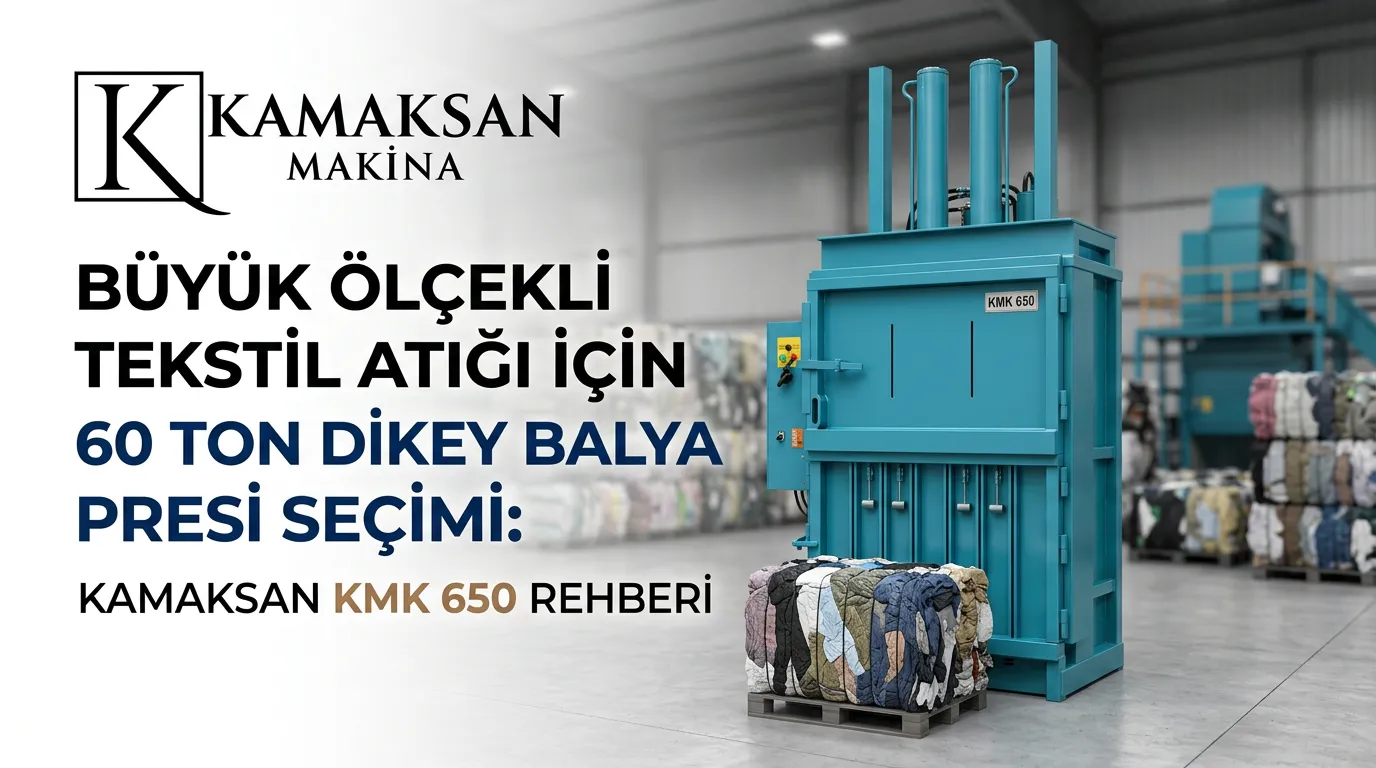
In today's industry, sustainability goals and increasing production volumes necessitate the effective management of textile waste. Especially for large-scale textile factories and recycling facilities, compressing and storing high daily tonnages of waste is a critical engineering problem in terms of operational costs and environmental impact. In this context, 60-ton pressing force vertical baling presses stand out as an indispensable solution for textile waste management.
The Role of Vertical Baling Presses in Textile Waste Management
Vertical baling presses are essential machines that reduce the volume of textile waste by up to 80%, lowering storage and transportation costs, and increasing operational efficiency. In large-scale textile waste streams, these machines ensure that waste is converted into regular, dense, and portable bales, thus providing ideal raw material preparation for recycling processes. As Kamaksan Makina, with over 30 years of experience, we develop engineering solutions for these needs.
Importance of 60-Ton Pressing Force for Large-Scale Textile Waste
In large-scale textile waste processing, a 60-ton pressing force is a critical requirement for effectively compacting high-density and voluminous textile materials. This pressing force allows for the creation of denser bales, maximizing the capacity of transport vehicles, saving storage space, and shortening operational cycle times. For factories and recycling facilities handling high daily tonnages of textile waste, a 60-ton press is key to managing the waste stream continuously and efficiently.
Kamaksan KMK 650 Vertical Baling Press: Technical Superiority and Efficiency
The Kamaksan KMK 650 Vertical Baling Press is an engineering marvel specifically designed for large-scale textile waste baling operations, featuring superior technical specifications. With its 60-ton pressing force, this machine can compact even the most challenging textile waste into high-density bales, making it one of the most efficient solutions in the industry.
- Pressing Force: A 60-ton pressing force is ideal for compacting various materials such as cotton, wool, synthetic fibers, and mixed textile waste into homogeneous and tight bales. This prevents bales from falling apart and increases transport safety.
- Motor Power: An 11 kW motor power ensures continuous and high-performance operation of the machine, while the optimized hydraulic system also offers energy efficiency. This translates into significant savings in operating costs.
- Bale Dimensions: 1500x1100x1100 mm (W/D/H) bale dimensions provide a perfect fit for standard shipping containers and truck trailers, guaranteeing maximum load and minimum void in logistics processes. These optimized dimensions allow for more waste bales to be loaded per shipment.
- Machine Weight: A weight of 2300 kg indicates that the machine has a stable and durable structure, offering long-lasting and reliable performance even under intense working conditions.
For more technical details and visual information about the Kamaksan KMK 650, please visit our product page: KMK 650 Vertical Baling Press Machine. Additionally, you can explore all our vertical baling press solutions in our category: Vertical Baling Press Machines.
Criteria for Choosing the Right Vertical Baling Press
Selecting the correct vertical baling press for large-scale textile waste baling processes is vital for long-term efficiency and cost-effectiveness. Here are the main criteria to consider:
Daily Processing Capacity and Waste Volume
The machine's daily waste tonnage capacity should match your facility's production volume. A 60-ton press is ideal for businesses generating high volumes of textile waste. The continuity and density of the waste stream determine the capacity of the press to be selected.
Bale Density and Dimensions
The density of the created bales and their suitability for standard shipping dimensions directly affect logistics costs. The KMK 650's 1500x1100x1100 mm bale dimensions offer an optimal solution in this regard.
Motor Power and Energy Efficiency
In applications requiring high pressing force, motor efficiency is important for energy consumption. An optimized 11 kW motor provides sufficient power while helping to minimize operating expenses.
Durability and Reliability
Long-lasting and trouble-free operation in industrial machinery is essential for production continuity. Kamaksan's over 30 years of experience, CE and ISO 9001:2015 certifications, 2-Year Full Engineering Warranty, and 10-Year Spare Parts Supply Guarantee are indicators of reliability in this regard.
| Criterion | Importance for Large-Scale Textile Waste | Kamaksan KMK 650 Solution |
|---|---|---|
| Pressing Force | Effective compaction of high-volume and dense textile waste, bale integrity | 60 Tons Pressing Force for maximum compaction and dense bales |
| Bale Dimensions | Reducing logistics costs, optimizing storage space | 1500x1100x1100 mm for standard shipping, optimal loading |
| Motor Power | Continuous operation, energy efficiency, operational costs | 11 kW Motor Power for high performance and optimized energy consumption |
| Durability & Warranty | Long-term investment, minimum downtime, after-sales support | 2300 kg weight, robust structure, 2-year engineering, 10-year spare parts warranty |
Contribution to Sustainability and the Recycling Economy
Choosing an efficient baling press not only reduces operational costs but also significantly contributes to businesses achieving their sustainability goals. Baling textile waste and integrating it into the recycling chain helps conserve natural resources, reduce greenhouse gas emissions, and support the circular economy. High-capacity machines like the Kamaksan KMK 650 maximize these environmental and economic benefits.
Frequently Asked Questions (FAQs)
Which Types of Textile Waste is the KMK 650 Suitable For?
The Kamaksan KMK 650 is suitable for baling a wide range of textile waste, including cotton, wool, synthetic fibers, mixed fabrics, woven and non-woven textile waste, scraps, and other bulky textile discards. Thanks to its high pressing force, it can effectively compact materials of different densities.
How Does High Pressing Force Affect Energy Consumption?
The KMK 650's 11 kW motor and 60-ton pressing force allow for the creation of denser and larger bales in fewer cycles. This means that the same amount of waste is processed with less operating time and fewer cycles, thus optimizing total energy consumption and increasing energy efficiency.
How Do Bale Dimensions Minimize Logistics Costs?
The 1500x1100x1100 mm bales produced by the Kamaksan KMK 650 perfectly comply with international shipping standards and container/truck trailer dimensions. These optimized dimensions prevent empty spaces in transport vehicles, allowing more waste bales to be loaded per unit of transport, thereby significantly reducing logistics and transportation costs.
What Are Kamaksan Makina's After-Sales Services?
As Kamaksan Makina, we offer our customers a 2-Year Full Engineering Warranty and a 10-Year Spare Parts Supply Guarantee. With our extensive service network and expert technical team, we provide fast and effective support in all processes, from installation to maintenance, troubleshooting, and spare parts supply. For detailed information or to request a quote, please contact us via our contact page.
In conclusion, large-scale textile waste management is a critical process that can provide both environmental and economic benefits with the right equipment selection. The Kamaksan KMK 650 Vertical Baling Press is designed to meet all expectations in this field with its 60-ton pressing force, optimized bale dimensions, and powerful motor. With over 30 years of experience in the industry, we are proud to offer the most suitable baling press solution for your business needs. To view all our products, please visit our products page.