

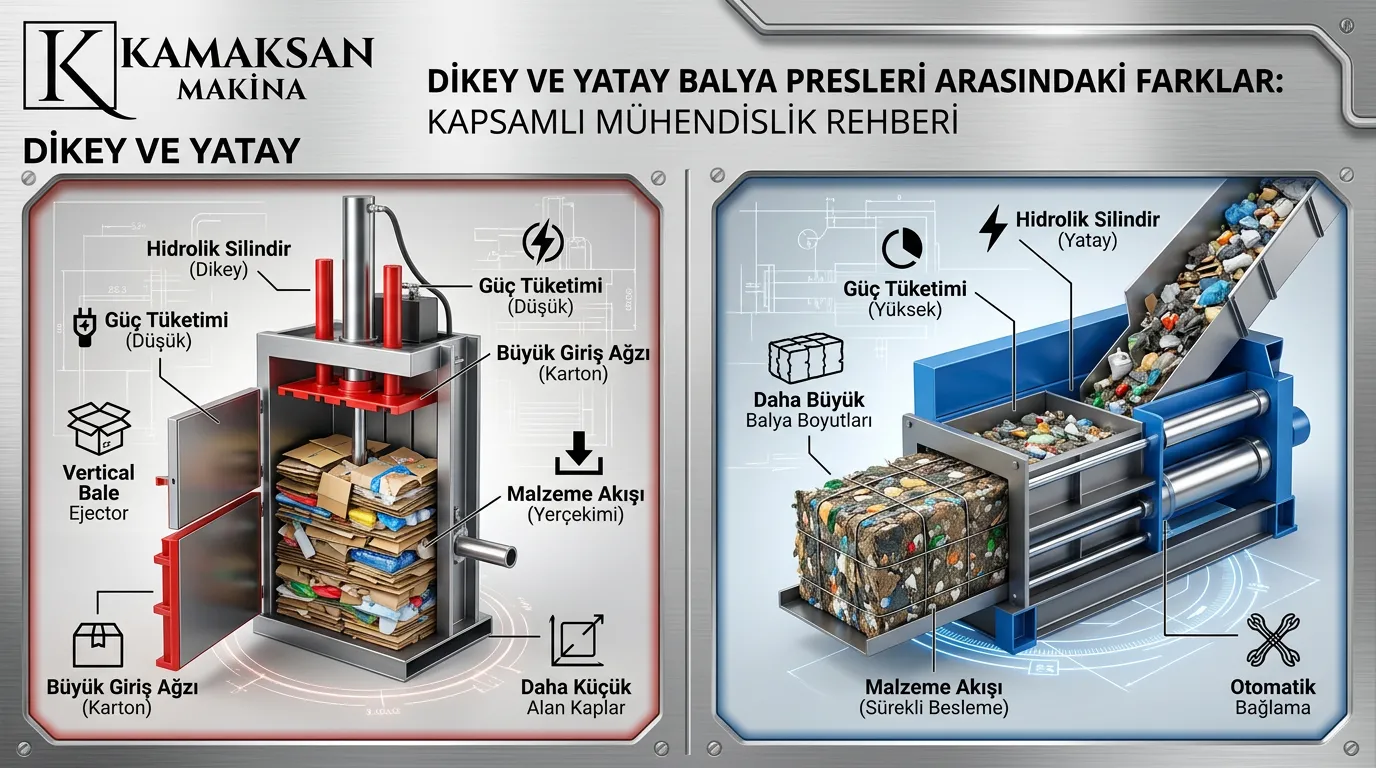
In the recycling and waste management sector, efficiency, cost-effectiveness, and operational ease are critically important for every business. In this context, compressing waste into transportable bales is a fundamental step that optimizes logistics processes and saves storage space. Industrial baling presses are at the heart of this transformation and are divided into two main categories according to businesses' needs: vertical baling presses and horizontal baling presses. With over 30 years of experience and engineering expertise at Kamaksan Machinery, we will delve into the fundamental differences, advantages, and scenarios in which each press type should be preferred.
The primary difference between vertical and horizontal baling presses is the compression direction of the waste material and the resulting operational capacity, automation level, and space requirements. Vertical presses generally occupy less space and are suitable for manual feeding, making them ideal for small and medium-sized businesses. Horizontal presses, on the other hand, are indispensable for industrial facilities processing high volumes of waste, thanks to their high capacity, continuous feeding, and automation-friendly structure.
Vertical Baling Presses: Compact Solutions and Flexibility
Vertical baling presses, as their name suggests, compress waste material from top to bottom using a ram to form bales. These presses are generally ideal for businesses with limited space due to their smaller footprint and lower space requirements. Manual feeding is usually sufficient, and they operate by the operator manually or with a small forklift emptying waste into the loading aperture at the top of the press.
One of the biggest advantages of vertical baling presses is their cost-effective initial investment and flexible placement options. Businesses such as retail stores, hotels, small manufacturing plants, warehouses, and restaurants prefer vertical presses to easily compress various materials like cardboard, plastic, and textile waste. Our models, such as KMK 40 (8 Ton pressing force, 1.1 kW motor) and KMK 60 (10 Ton pressing force, 1.5 kW motor), found in Kamaksan Machinery's Vertical Baling Presses category, offer high efficiency despite their compact size, meeting the waste management needs of small and medium-sized businesses. For larger volumes, models like KMK 250 (30 Ton pressing force, 4 kW motor) are also available.
Key Features of Vertical Baling Presses:
- Space Efficiency: Generally occupies less space, can be positioned in narrow areas.
- Manual Feeding: Fed manually by an operator or with simple equipment.
- Lower Initial Cost: More affordable compared to horizontal presses.
- Various Waste Types: Can process different materials such as cardboard, plastic, textiles, and film.
- Easy Installation: Generally requires less complex installation processes.
Horizontal Baling Presses: High Capacity and the Power of Automation
Horizontal baling presses compress waste material in a horizontal direction to form bales. These presses are larger in size and have higher pressing forces compared to vertical presses. Their most distinctive feature is their ability to offer continuous feeding and a high level of automation. Material can be continuously fed via conveyor belts, pneumatic feeding systems, or forklifts, minimizing human intervention and maximizing operational efficiency.
Horizontal baling presses are designed for businesses processing high volumes of waste, such as large-scale recycling facilities, paper mills, large distribution centers, industrial manufacturing plants, and waste collection centers. Thanks to high bale density and large bale sizes, they provide significant savings in logistics costs. At Kamaksan Machinery, we offer high-performance Horizontal Baling Presses solutions tailored to our customers' specific needs. These machines guarantee uninterrupted operational performance with their heavy-duty construction and long-lasting components.
Key Features of Horizontal Baling Presses:
- High Capacity: Ability to process large volumes of waste quickly and continuously.
- Automatic Feeding: Integration with conveyor belts or other automatic systems.
- High Bale Density: Creates tighter and more uniform bales, reducing transportation and storage costs.
- Continuous Operation: Capable of uninterrupted operation, can be integrated into production flow.
- Wide Range of Applications: Processes a wide variety of industrial waste such as paper, cardboard, PET bottles, metal, and textiles.
Key Engineering Differences Between Vertical and Horizontal Baling Presses
Understanding the engineering and operational differences between vertical and horizontal baling presses is vital when determining your business's waste management strategy. As Kamaksan Machinery, we have summarized the key comparison of these two press types in the table below:
| Feature / Criterion | Vertical Baling Press | Horizontal Baling Press |
|---|---|---|
| Compression Direction | Top-down (vertical) | Side-to-side (horizontal) |
| Capacity | Low - Medium (a few bales per hour) | High - Very High (continuous, many bales per hour) |
| Footprint / Space Requirement | Compact, occupies less space | Occupies more space, longitudinal placement |
| Feeding Mechanism | Generally manual (by hand or with forklift) | Automatic (conveyor, pneumatic feeding) or with forklift |
| Bale Density | Medium | High |
| Bale Dimensions | Generally small and medium | Large and industrial standard |
| Automation Level | Low | High (fully automatic models available) |
| Initial Investment Cost | More affordable | Higher |
| Operational Costs | Low labor (manual feeding), energy consumption varies by capacity | Unit cost is low for high-volume waste, energy consumption can be higher |
| Material Variety | Cardboard, plastic film, textile, PET | Cardboard, PET, metal, paper, textile, rubber, etc. wide range |
| Application Areas | Retail, hotel, small factory, warehouse | Recycling facilities, large industry, distribution centers |
Which Baling Press is Right for You? Selection Criteria
Choosing the right baling press depends on your business's specific needs and waste management goals. With our 30 years of experience at Kamaksan Machinery, we have identified the key criteria you should consider in the decision-making process:
- Waste Volume and Type: How much waste do you generate per day? What type of waste do you have (cardboard, plastic, metal, textile)? Vertical presses may be sufficient for small to medium volumes of various wastes, while horizontal presses are more efficient for large volumes of homogeneous waste.
- Available Space: How much space can you allocate for the machine in your facility? If space is limited, compact vertical presses (e.g., KMK 40 or KMK 60) would be more suitable.
- Labor and Automation Needs: How much labor can you allocate for waste feeding and bale tying operations? Are you looking for an automatic or semi-automatic system? Horizontal presses should be preferred for high automation and continuous operation.
- Budget and Return on Investment (ROI): Are the initial investment cost and long-term operational costs within your budget? Although the initial cost of higher-capacity horizontal presses is higher, they can offer a higher return on investment in the long run through logistics and labor savings.
- Bale Density and Size Requirements: How important are bale density and dimensions for you in terms of transportation and storage? Horizontal presses are more effective for tighter and larger bales.
Frequently Asked Questions (FAQs)
Which materials are vertical baling presses more suitable for?
Vertical baling presses are generally ideal for compressing light to medium density materials such as cardboard, plastic film, PET bottles, aluminum cans, textile waste, and styrofoam. They are highly effective for the daily waste volume of small and medium-sized businesses.
What types of waste can horizontal baling presses process and in which sectors are they used?
Horizontal baling presses can process a wide variety of materials at high capacity, including cardboard, paper, PET bottles, metal packaging, textiles, and even some non-hazardous industrial waste. They are particularly preferred in sectors that generate high volumes of waste, such as recycling facilities, large warehouses, industrial zones, logistics centers, and paper mills.
How important is energy efficiency in baling press selection?
Energy efficiency is a critical factor, especially in continuously operating and high-capacity presses, as it directly affects operational costs. At Kamaksan Machinery, we aim to minimize businesses' energy consumption by focusing on optimal motor power and hydraulic system efficiency in the design of our machines. It is important to consider models with high-efficiency motors to save on energy costs in the long run.
How can Kamaksan Machinery help me choose the most suitable press for my business?
With over 30 years of industry experience and engineering expertise, Kamaksan Machinery evaluates all parameters such as your business's waste type, volume, available space, and budget to offer customized solutions. Our expert team can analyze your needs to determine the most efficient vertical or horizontal baling press model and even help you design custom-made machines. Do not hesitate to contact us to make the right choice and ensure long-term efficiency.
Conclusion
Vertical and horizontal baling presses are valuable industrial machines, each with its own advantages and application areas. Making the right choice plays a key role in the success of your business's waste management strategy. While vertical presses are ideal for small spaces and medium-volume waste, horizontal presses are indispensable for large-scale operations requiring high capacity and automation. As Kamaksan Machinery, with over 30 years of engineering experience, CE and ISO 9001:2015 certified production, 2 years full engineering warranty, and 10 years spare parts supply guarantee, we are proud to offer the most suitable, reliable, and efficient baling press solutions for businesses of all sizes. To optimize your waste management processes and contribute to a sustainable future, you can visit our Baling Presses page or contact our expert team directly.