

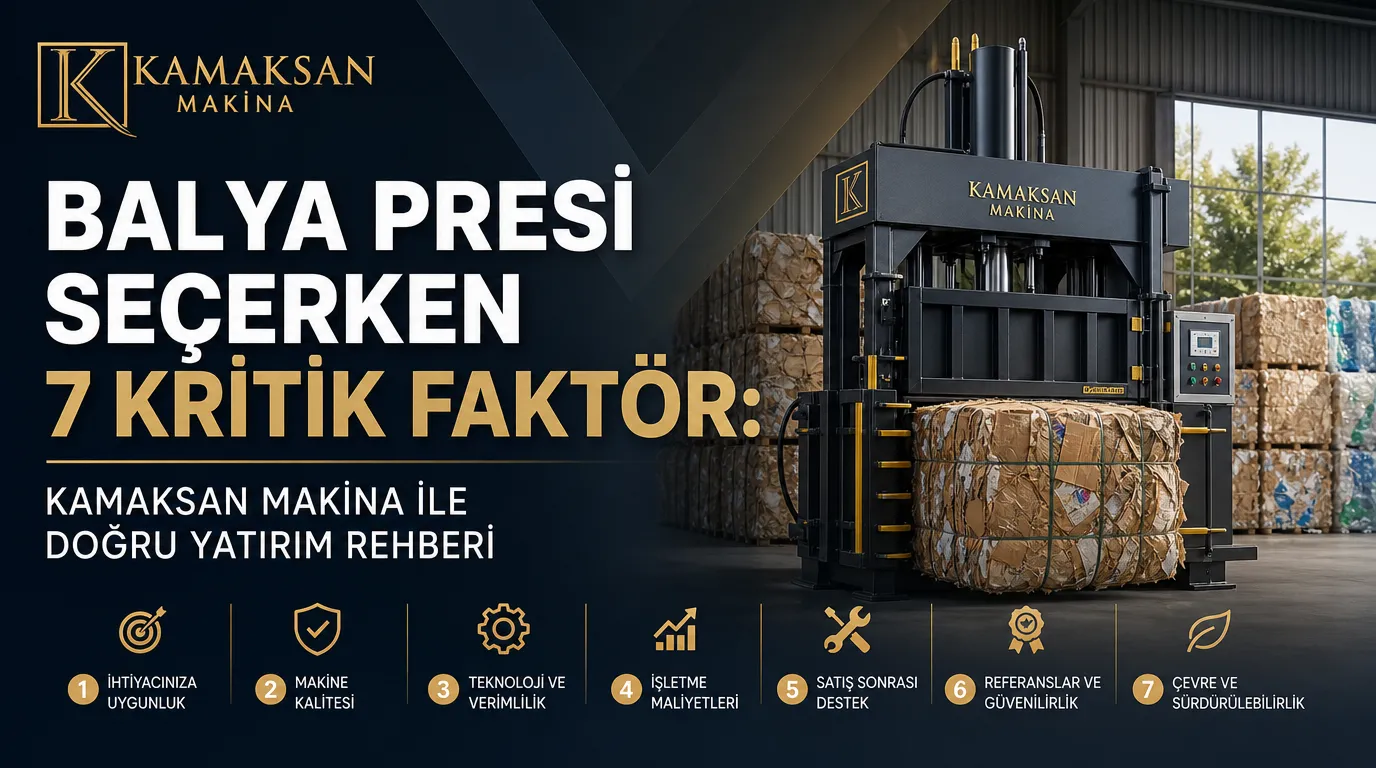
For businesses operating in the waste management and recycling sector, choosing the right baler is a critical step towards achieving operational efficiency, cost savings, and sustainability goals. With numerous models and configurations available on the market, the decision-making process can be complex. In this technical guide, Kamaksan Machinery, with over 30 years of engineering experience, will delve into 7 fundamental factors you should consider when selecting a baler.
Waste Type and Volume: Accurately Determine Your Needs
The first and most crucial step in baler selection is to clearly define the type and daily volume of waste to be processed. Different waste materials (paper, cardboard, plastic, PET bottles, textiles, metal, aluminum) require varying compaction forces and bale densities.
For instance, lower tonnage presses might suffice for light packaging waste or cardboard, while machines with higher pressing power should be preferred for bulky and flexible materials like PET bottles or dense textile waste. Your daily or hourly waste generation volume plays a key role in determining the machine's capacity and automation level. Meticulously analyzing waste for the correct machine selection makes a significant difference in terms of efficiency and cost. For more information on waste types and pressing capacities, please visit our products page.
Compaction Force and Bale Density: The Key to Efficiency
Compaction force (tonnage) and the resulting bale density are the most critical technical specifications directly affecting a baler's performance. High compaction force creates denser bales, saving storage space and significantly reducing transportation costs.
Dense bales allow more material to be transported in the same shipping volume. This is a major advantage, especially for long-distance shipments or businesses with limited storage space. Kamaksan Machinery's models like the KMK 250 (30 tons) or the KMK 650 (60 tons) for large-scale applications, maximize operational efficiency by offering optimal bale density for various waste types.
Machine Type: Vertical or Horizontal?
Baling presses are fundamentally divided into two main categories: vertical and horizontal, each with its unique advantages and applications. Your business's physical space, waste volume, and operational flow will determine which type is more suitable.
Vertical Baling Presses generally occupy less space, are ideal for manual feeding, and are suitable for small to medium waste volumes. They are particularly preferred in retail, hospitality, or small manufacturing facilities. For example, Kamaksan's KMK 40 (8 tons) and KMK 60 (10 tons) models offer ideal solutions for small businesses with their compact designs. Horizontal Baling Presses, on the other hand, have continuous feeding capacity and are designed to process higher waste volumes. They typically work integrated with automatic feeding systems and are suitable for large recycling facilities or production lines. For more comprehensive information on the differences between vertical and horizontal balers, you can refer to our Comprehensive Engineering Guide.
| Feature | Vertical Baling Press | Horizontal Baling Press |
|---|---|---|
| Space Requirement | Less (Vertical Design) | More (Horizontal Design) |
| Feeding Method | Generally Manual | Automatic or Semi-Automatic |
| Capacity | Small - Medium Volume Waste | Medium - Large Volume Waste |
| Waste Types | Various (Cardboard, Plastic, Textile) | Various (Cardboard, Plastic, PET, Metal) |
| Bale Tying | Manual or Semi-Automatic | Automatic |
| Application Area | Retail, Hotel, Small Facilities | Recycling Facilities, Industry |
Automation Level and Operational Ease
The automation level of a baler directly impacts labor costs, operational speed, and safety. Manually fed and tied models may be suitable for businesses with low waste volumes and budget constraints, while semi-automatic or fully automatic systems offer higher efficiency and minimal operator intervention.
At Kamaksan Machinery, we produce CE and ISO 9001:2015 certified machines equipped with double safety locks and operator protection sensors, ensuring the highest level of operator safety. Intuitive control panels that provide ease of use and designs that offer easy maintenance reduce operational costs in the long run.
Energy Efficiency and Operating Costs
Since balers operate via hydraulic systems, energy consumption constitutes a significant portion of operating costs. Modern balers are equipped with motors and hydraulic pumps designed to increase energy efficiency.
A machine with low energy consumption can lead to significant savings in the long term. For example, the KMK 40 model offers an economical solution with only 1.1 kW motor power, while the KMK 80 model, requiring higher compaction force, delivers powerful performance with 3 kW motor power. Additionally, regular maintenance requirements, spare part costs, and the overall durability of the machine are factors that affect the total operating cost.
Durability and Warranty: A Long-Lasting Investment
Industrial machinery must be designed to withstand heavy operating conditions. The durability of a baler is directly related to the quality of materials used, manufacturing standards, and engineering approach. Robust steel construction, quality hydraulic components, and reliable electrical systems are indispensable for a long-lasting investment.
Kamaksan Machinery demonstrates its confidence in the quality of its products by offering a 2-Year Full Engineering Warranty on all its products. Furthermore, we guarantee your business's operational continuity with a 10-Year Uninterrupted Original Spare Part Supply Guarantee. These guarantees protect you against potential malfunctions and ensure your machine operates smoothly for many years.
After-Sales Support and Service Network
When purchasing a baler, the after-sales support and technical service provided by the manufacturer are as important as the machine itself. Fast and effective service support in case of potential malfunctions or maintenance needs minimizes operational downtime and maintains efficiency.
As Kamaksan Machinery, we offer direct factory support to our customers worldwide through our global after-sales technical service network. We ensure your machine always operates at peak performance with rapid on-site service intervention and continuous operational guidance. Receiving support from a reliable manufacturer is key to preserving the value of your investment and long-term success. To get technical support or a special quote, please contact us via our contact page.
Frequently Asked Questions (FAQs)
What is the most important factor when choosing a baler?
The most important factor in baler selection is the type and daily volume of waste to be processed. These two criteria directly influence all other technical specifications of the machine, such as compaction force, type (vertical/horizontal), and capacity. A selection made without proper analysis can lead to operational inefficiency and unnecessary costs.
What are the main differences between vertical and horizontal balers?
Vertical balers generally occupy less space, are suitable for manual feeding, and are ideal for small to medium waste volumes. Horizontal balers, on the other hand, have higher capacities, typically work with automatic feeding systems, and are designed to continuously process large volumes of waste.
What warranty and service advantages do Kamaksan balers offer?
Kamaksan Machinery offers a 2-Year Full Engineering Warranty and a 10-Year Uninterrupted Original Spare Part Supply Guarantee for all its balers. Additionally, with its global after-sales technical service network, it provides direct factory support, rapid on-site intervention, and continuous operational guidance, prioritizing customer satisfaction.
Choosing the right baler is one of the most strategic steps you can take to optimize your business's waste management processes and achieve your sustainability goals. With over 30 years of experience, Kamaksan Machinery is here to offer you the most suitable solution. By contacting our expert engineers, we can jointly determine the most efficient and economical baler solution according to your business's specific requirements. For more information or to get a quote, contact us now.